Inserts for Rigid Boxes: Card, Foam and Satin Compared
Choosing an insert that holds your product still, presents it well and survives the journey across the UK.
What does an insert actually do?
An insert has three jobs. It holds the product still, it shows it off when the lid opens, and it spreads the knocks of the journey.
A box with no insert relies on the product fitting the walls exactly. That works for a folded shirt; it fails for a 300 g bottle that can swing about.
Each of the three main types, card, foam and satin-lined, is an option on request. Each one handles those three jobs differently.
The right choice depends on weight, fragility and how the box will be opened. A keepsake opened at a table needs a different insert from a kit sent through the post.
Card inserts: platforms, slots and trays
Card inserts are folded or wrapped board shapes. The simplest is a raised platform, a flat panel on legs that lifts a short item nearer the lid.
Others are slotted panels that hold cards, phones or bottles upright, or trays with cut-out wells. Wrapped greyboard versions use board about 1.5 to 2 mm thick, covered in the same paper as the box.
A platform is useful when a product is shorter than the box needs to be. Lifting a 20 mm item by 30 mm brings it up to meet the eye as the lid opens.
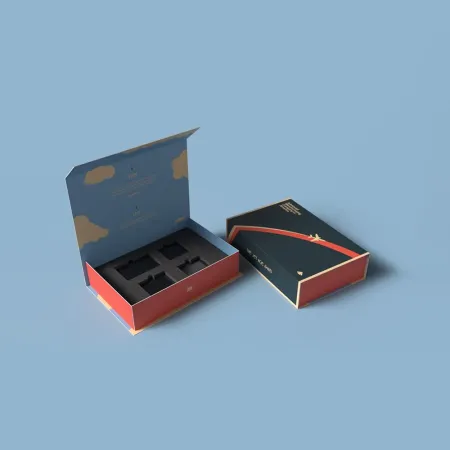
Card inserts suit flat goods, stationery and anything not easily scratched. The rigid boxes with card and foam inserts show slotted and platform types.
Slots for cards should be about 1 mm wider than the card thickness plus any envelope, so the card slides in without bending.
Foam inserts: cut to the product shape
Foam inserts are cut with cavities that match the product outline. They grip best when the cavity is about 1 mm smaller than the item, so the foam presses lightly on every side.
Common foam depths run from 10 mm for a slim item to 50 mm for a bottle or a watch on its side. Leave 5 to 10 mm of solid foam under each cavity.
Foam can be layered, with a solid base and a cut top sheet. That gives clean cavity walls and a flat floor for the item to rest on.
Foam is the safest choice for glass, electronics and heavy pieces. Many watch boxes with cushioned inserts pair a foam base with a softer top layer.
Satin-lined inserts for jewellery and keepsakes
A satin-lined insert is a padded card shape covered in satin fabric. It can be a flat bed, a slotted ring roll or a raised pad with a hook for a pendant.
Satin suits pieces that are bought to be kept, because the fabric looks soft against metal and stones. It is less precise than foam, so it needs the box sized closely.
Ring slots are a common satin layout: a padded roll with a narrow slit about 3 mm wide that grips the band.
A padded pad for a necklace usually stands about 15 to 20 mm high. Our necklace boxes with satin-lined pads show how the chain drapes over it.
Pale satin shows marks from handling during packing. Cream, black and navy are forgiving shades if many people will touch the inserts.
Card, foam and satin side by side
Most buyers choose between the three types by weight and fragility.
| Insert | Typical depth | Best at | Less suited to |
|---|---|---|---|
| Card platform | 10 to 40 mm lift | Raising a flat or short item | Heavy, loose objects |
| Card slots or wells | 15 to 50 mm | Cards, tubes, upright bottles | Odd shapes |
| Foam with cavities | 10 to 50 mm | Glass, electronics, heavy sets | A soft, fabric look |
| Satin-lined pad | 10 to 25 mm | Jewellery, watches, keepsakes | Heavy items in the post |
| Foam with fabric top | 20 to 40 mm | Grip plus a softer look | Very tight budgets of space |
You can also mix types. A foam base under a satin-covered top layer gives grip plus the soft look of fabric. It costs a little extra depth.
How deep should an insert cavity be?
A useful rule is to sink the product at least half its height into the insert. Two thirds is better for anything heavy or tall.
A 60 mm bottle therefore wants a cavity 30 to 40 mm deep. Add the 5 to 10 mm of foam beneath it, and the insert is 35 to 50 mm thick.
Shallow cavities look good in a photo but let items tip out when the box is turned over. Deep cavities hide too much, so the product needs a pull to lift it.
For flat items like cards or a slim pouch, a cavity of 5 to 10 mm is plenty. The aim is simply to stop sideways movement.
Finger notches and lift ribbons
Anything sunk deeply needs a way out. A finger notch is a half-moon cut beside the cavity, usually 20 to 25 mm wide and as deep as the product.
A lift ribbon runs under the product with both ends tucked beside it. Pulling the ribbon raises the item, which suits watches and bottles that fill their cavity.
Ribbons are typically 6 to 10 mm wide. Ask for them on the brief so the insert is cut with a slot for the ribbon ends.
Place the notch on the side the customer naturally reaches from, usually the front edge as the box faces them.
Planning inserts for sets and kits
Multi-item boxes need the most planning, because each piece has its own shape and weight.
Kits for launches and staff gifts are where these rules matter most, and the corporate and PR box range shows several fitted layouts.
- Leave 8 to 10 mm of insert between neighbouring cavities so the walls do not tear.
- Put the heaviest piece in the centre to keep the box level when lifted.
- Keep cards and leaflets in a slot or under a flap rather than loose on top.
- Match each cavity to the real product, not a drawing, and include caps and tags.
- Check the insert depth against the lid, with 2 to 3 mm clearance above the tallest item.
How do I brief an insert?
A good brief saves a round of proofs. Send the following with your request.
When you are ready, add these details to a written quote for your boxes and the insert is priced with the box.
- List every item with its size in millimetres and its weight in grams.
- Say how each piece should sit: flat, upright or on its side.
- Choose card, foam or satin-lined, or ask us to suggest one.
- Mention any notches, ribbons or slots you want for lifting pieces out.
- Send one sample set if the shapes are irregular, so we cut from the real items.
- Check the insert drawing on the free proof before approving it.
Do inserts protect a box in the post?
Inserts protect the product inside the rigid box. They do not replace the outer shipping carton, which takes the knocks of the journey.
Think of the insert as protection for the product and the carton as protection for the box. Each covers a different risk.
Before ordering in quantity, shake a packed sample gently from side to side. If anything moves, the cavity is too large or the insert is too shallow.
Turn the closed box upside down as well. A product that drops onto the lid will mark the wrap from the inside over a long journey.