Planning a PR Box Send-Out: Timeline, Contents and Packaging
A working timeline for a UK PR or influencer send-out, from brief and proof to packing day.
What a PR box has to do
A PR box is opened once, often on camera, by someone who receives a lot of parcels. It has a few seconds to look different from the rest.
It also has to survive the post, arrive with nothing loose, and explain itself without a phone call. The packaging carries the message as much as the product does.
Most recipients keep a box they like and reuse it. A sturdy rigid box with a clean logo can sit on a shelf in the background of later videos.
Planning starts with the date the boxes must land, then works backwards through every stage.
How long does a PR box send-out take to plan?
For a first send-out, allow about four weeks from brief to the boxes landing on doorsteps. A repeat order with approved artwork can move faster.
The table shows a typical working timeline using our usual timings. Treat it as a plan, not a promise of dates, because approvals and your own packing time vary.
Agency send-outs often tie in with an embargo or a launch event. If yours does, set the landing date two or three days before it, so late parcels still arrive in time.
| Stage | Typical time | Who does it |
|---|---|---|
| Brief, product list and sizes | 2 to 5 days | Your team |
| Written quote | Within one business day | Us |
| Artwork and free design proof | 2 to 5 days, depending on changes | Our designers and you |
| Production after proof approval | 4 to 6 business days | Us |
| Free tracked UK delivery to you | 2 to 3 business days | Us |
| Packing day | 1 to 3 days for a few hundred boxes | Your team |
| Posting to recipients | Depends on your chosen service | Your team |
The step that slips most often is proof approval. Name one person who signs off, and give them the deadline in writing.
A working timeline in eight steps
Count back from the day you want boxes opened, and leave slack at the end, not the start.
Write the dates you plan for each step into a shared calendar, and add a named owner beside every one.
- Fix the landing date and the number of recipients, then add 5 to 10 per cent spare boxes.
- Collect every item that goes in the box and measure each one in millimetres.
- Choose the box style and insert, and send the brief for a written quote.
- Send logo and artwork, or ask our designers to place it on the free proof.
- Approve the proof, checking sizes, inside print and spelling of every word.
- Plan packing while the boxes are in production for 4 to 6 business days.
- Receive the boxes, count them and pack a test box before the full run.
- Pack, seal the outer cartons, label and post on the day you planned.
What should go inside a PR box?
Less is usually better. One hero product with a clear story films better than a dozen samples.
Plan contents by what the recipient does on camera: lifts the lid, reads the card, picks up the product.
Weigh the packed box once the contents are fixed. A full PR kit often lands between 500 g and 1.5 kg, which affects the outer carton and postage you choose.
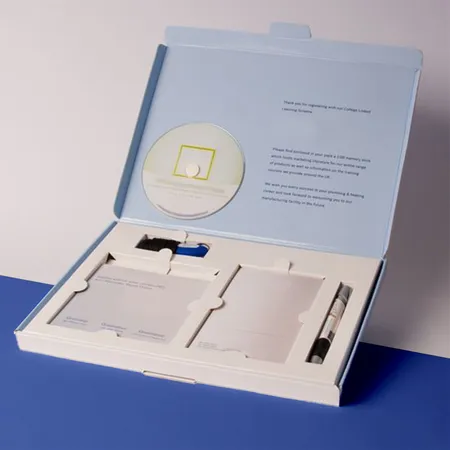
- The hero product, held in an insert so it sits centre stage.
- A message card, ideally under 60 words, with the launch date and a contact.
- Printed inside lid with a short line that reads well in a video.
- One or two supporting items, not a pile of extras.
- A small card with the product name, price point and where to buy, if you share them.
- Nothing loose that could rattle or spill.
Which box style looks best when filmed?
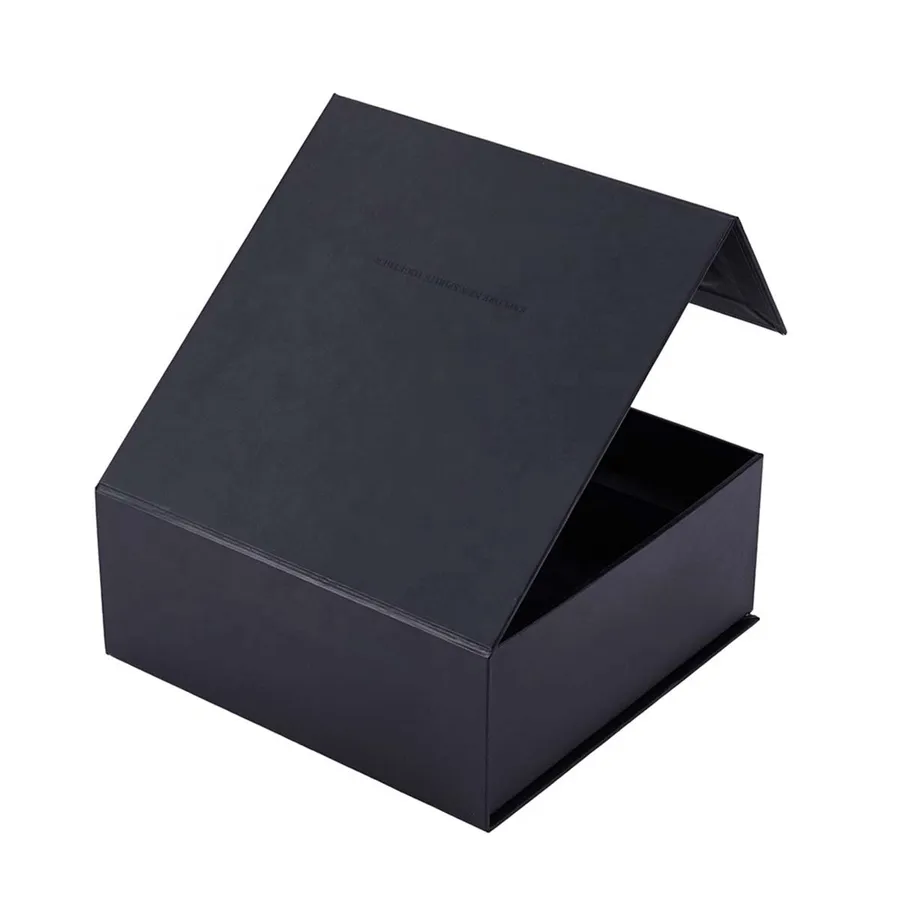
Book-style and magnetic boxes film well, because the lid swings up towards the camera and shows the inside print. A lift-off lid is slower but builds a moment of suspense.
Drawer boxes work for small items, and the pull can be a branded ribbon. Whatever the style, a printed inside lid is the first thing a viewer sees.
Colour matters on screen too. Mid and dark tones film well, while pure white lids can flare under ring lights and lose their print.
Most send-outs we see use one of the PR boxes built for unboxing videos, with a hinged cover and a fitted tray.
Sizing a mixed set of contents
PR kits often hold four or five items of different shapes. Each needs a cavity, and each cavity needs a wall of 8 to 10 mm around it.
Keep the box to a size that sits comfortably on a lap or a desk, roughly 300 x 220 mm or smaller. Very large boxes are hard to film in one shot.
Lay the items out at full size on paper before you send dimensions. Cavity depths and finger notches are covered step by step in our guide to rigid box inserts.
Printing inside the lid and on the cover
The inside of the lid is prime space. A one-line message there often appears in every video, while the outside lid is seen once.
On a book-style box, the inside cover is a large panel facing the reader. The book-style boxes with a printed inside cover show how much text fits comfortably.
Keep the outside simple: a logo in foil or deboss reads well in close-up shots.
Check every word of inside print on the proof with a second reader. A typo inside the lid is filmed far more often than one on the base.
How long does packing day take?
Packing takes longer than people expect. Two people working steadily can often pack 30 to 50 fitted boxes an hour, once everything is laid out.
Set up a line: open boxes, insert products, add the card, close, place in an outer carton, seal and label. Keep spares of every item within reach.
Pack a test box first and photograph it. That picture becomes the reference for everyone on the line.
Keep a printed checklist at the end of the line. Tick each item off as the final box is closed, so nothing goes out missing a card or a sample.
Posting PR boxes to recipients across the UK
A rigid box should never travel with only a label on it. Put each one in an outer carton 5 to 10 mm larger on every side, with paper fill around it.
Check addresses against a single spreadsheet and print labels from it, not from emails. Keep a note of each tracking number beside each name.
Stagger posting if the list is long. Sending in two or three batches lets you catch an address problem before every parcel has gone.
If you are planning staff or client gifts as well as press, the range of corporate and PR boxes shows options for both.
Mistakes that delay a send-out
Late artwork is the main one. Each round of proof changes can add a day or two, so gather all comments before replying.
Wrong counts come next. Order spares for damaged boxes, late additions and your own archive copies.
A third is a recipient list that keeps growing after the order is placed. Freeze the list on the day you approve the proof, and treat late names as spares.
Finally, sending boxes before the product is ready. Book production only once you know the product will arrive in time to pack, then send your brief for a written quote.